The global maritime industry runs on bunker fuel — and the market that supplies it is on a powerful, decade-long growth trajectory. Driven by rising international trade volumes, sweeping environmental regulations, and rapid technological innovation in fuel management, the global bunker fuel market is evolving at a pace that demands close attention from industry stakeholders, investors, and policymakers alike.
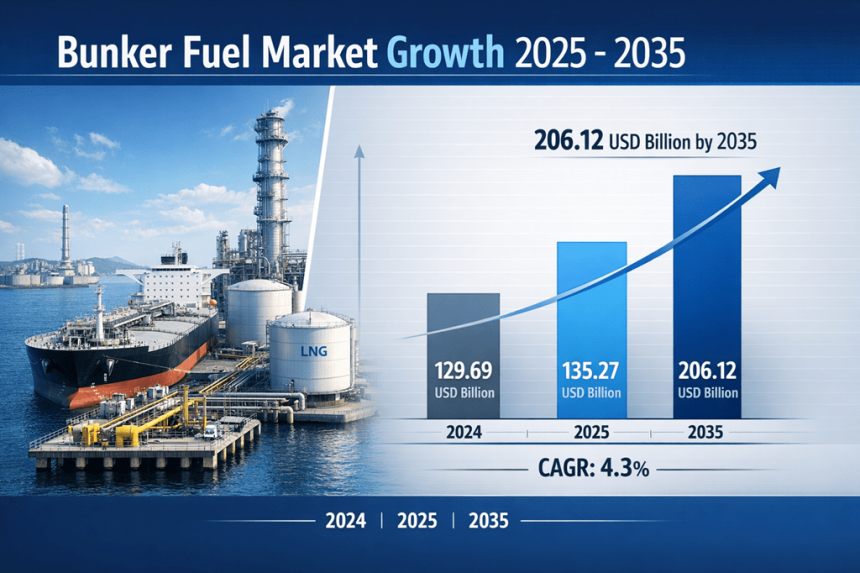
According to the Market Research Future, the global bunker fuel market was valued at USD 129.69 billion in 2024 and is projected to climb from USD 135.27 billion in 2025 to USD 206.12 billion by 2035, registering a steady compound annual growth rate (CAGR) of 4.3% over the forecast period from 2025 to 2035.
What Is Bunker Fuel?
Bunker fuel refers to the fuel oil supplied to ships engaged in international and domestic maritime navigation. The term “bunkering” describes the process of fueling a vessel, and the grades of fuel used vary by vessel type, engine specification, and regional regulatory requirements. The main categories include High Sulfur Fuel Oil (HSFO), Low Sulfur Fuel Oil (LSFO), Marine Gasoil (MGO), and emerging alternatives such as Liquefied Natural Gas (LNG) and biofuels.
Residual fuel — the denser, less refined form of bunker fuel — historically accounts for the majority of consumption, while distillate fuels like MGO are used in smaller, higher-rated diesel engines found across various vessel types. As environmental standards tighten, the composition of the bunker fuel mix is undergoing a notable transformation.
Key Market Drivers
1. Rising Global Trade and Shipping Activities
International seaborne trade remains the backbone of global commerce, with over 80% of world trade by volume transported by sea. As economies expand and e-commerce drives demand for faster, more reliable shipping routes, the maritime sector continues to grow in both volume and complexity. The global shipping industry is on a trajectory of approximately 4% annual growth, which directly amplifies the demand for bunker fuel across container ships, bulk carriers, tankers, and cargo vessels.
2. Regulatory Compliance and Emission Standards
The International Maritime Organization’s (IMO) 2020 sulfur cap — which reduced the permissible sulfur content in marine fuels from 3.5% to 0.5% globally — has been one of the most transformative regulatory events in the bunker fuel industry’s history. This mandate has compelled shipping operators to either switch to low-sulfur fuel alternatives or install exhaust gas cleaning systems (scrubbers) on existing vessels. The resulting surge in demand for LSFO and MGO is a direct and sustained driver of market growth, with further regulatory tightening expected through 2035.
3. Technological Innovations in Fuel Management
Digital transformation is reshaping how shipping companies monitor and manage fuel consumption. Real-time fuel monitoring systems, predictive analytics platforms, and AI-powered route optimization tools are enabling operators to achieve meaningful reductions in fuel consumption — estimated at up to 10% in favorable conditions. These innovations not only reduce operating costs but also support compliance with increasingly rigorous emissions targets, making fuel management technology a critical competitive differentiator.
4. Investment in Port Infrastructure
The expansion and modernization of port facilities worldwide is a vital enabler of bunker fuel market growth. As shipping volumes rise, ports in key maritime hubs — including Singapore, Rotterdam, Houston, and Fujairah — are investing in enhanced storage, supply infrastructure, and bunkering services. These developments reduce vessel turnaround times, ensure reliable fuel supply, and attract more shipping traffic, creating a virtuous cycle that stimulates further bunker fuel demand.
Download Report Sample Copy: https://www.marketresearchfuture.com/sample_request/10871
5. Geopolitical Factors and Supply Chain Dynamics
Geopolitical tensions, trade disputes, and regional conflicts introduce volatility into bunker fuel supply routes and pricing. Disruptions in oil-producing regions can create temporary supply shortages, prompting shipping companies to diversify their fuel procurement strategies. While such factors can introduce uncertainty, they also incentivize innovation in supply chain resilience and alternative fuel adoption, ultimately shaping the long-term structure of the market.
Market Segment Insights
By Fuel Type: Low Sulfur Fuel Oil Leads
Among the fuel types — HSFO, LSFO, Marine Gasoil, and others — Low Sulfur Fuel Oil has emerged as the dominant segment, capturing approximately 65–70% of market revenue. The adoption of IMO 2020 compliance frameworks has been the primary catalyst for this shift. LSFO and VLSFO (Very Low Sulfur Fuel Oil) are now the standard for most ocean-going vessels. Meanwhile, LNG is gaining ground as an alternative bunker fuel, with expanded infrastructure in ports such as Marseille and growing investment from energy companies and shipping lines in LNG-powered vessels.
By Commercial Distributor: Oil Majors at the Helm
The bunker fuel distribution landscape is segmented into Oil Majors, Large Independent Distributors, and Small Independent Distributors. Oil Majors currently hold the dominant share and are projected to be the fastest-growing distributor segment through 2035. Companies like Shell Marine, BP Marine, and TotalEnergies Marine Fuels leverage integrated supply chains, global port networks, and strong balance sheets to offer competitive, reliable bunkering services to major shipping operators.
By Application: Containers and Bulk Carriers
The container vessel segment accounts for the largest share of bunker fuel consumption by application, driven by the booming global containerized trade and the enormous fuel demands of ultra-large container ships. Bulk carriers, oil tankers, chemical tankers, gas tankers, and fishing vessels round out the key application segments, each with distinct fuel preferences and consumption profiles.
Regional Market Overview
North America — Energy Transition Leader
North America holds the largest regional share at approximately 35% of the global market. The United States and Canada benefit from robust maritime trade volumes, advanced port infrastructure, and a mature regulatory environment. Key bunkering hubs include ports along the Gulf Coast and the California coast, where compliance with both federal and state-level emissions standards drives demand for cleaner fuel solutions.
Europe — Regulatory Compliance Focus
Europe accounts for around 30% of global bunker fuel demand, positioned as the second-largest regional market. The European Union’s aggressive emissions reduction agenda has been a powerful force in accelerating the shift toward low-sulfur and alternative marine fuels. The Netherlands and Germany are particularly active markets, with Rotterdam serving as one of the world’s busiest bunkering ports and a hub for innovative fuel solutions.
Asia-Pacific — Fastest-Growing Region
The Asia-Pacific region, holding approximately 25% of global market share, is the most dynamic growth engine in the bunker fuel landscape. China and Singapore are the dominant maritime powerhouses, with Singapore consistently ranking among the world’s top bunkering ports by volume. Rapid urbanization, expanding commercial fleets, and government-led emissions reduction campaigns are collectively driving demand. The region’s strategic position at the nexus of major global shipping lanes makes it indispensable to the global bunker fuel supply chain.
Middle East and Africa — Resource-Rich Opportunities
The Middle East and Africa contribute approximately 10% of global market share, with the UAE — particularly Fujairah — serving as a critical bunkering hub for vessels transiting the Strait of Hormuz. The region’s abundant hydrocarbon resources and expanding port infrastructure position it well for continued growth as global shipping volumes rise.
Buy Now: https://www.marketresearchfuture.com/checkout?currency=one_user-USD&report_id=10871
Competitive Landscape
The bunker fuel market features a blend of integrated oil majors and specialized independent suppliers. Key players profiled in the include World Fuel Services (US), Bunker Holding (Denmark), Chemoil (Singapore), GAC Bunker Fuels (UAE), Aegean Marine Petroleum (Greece), Fujairah Oil Terminal (UAE), Shell Marine (UK), TotalEnergies Marine Fuels (France), and BP Marine (UK).
Strategic priorities in this competitive landscape include localized production to reduce logistics costs, investment in digital fuel management platforms, partnerships with LNG and biofuel suppliers, and acquisitions to expand geographic reach. Neste Oyj has made strides in low-sulfur marine fuels, while Titan LNG continues to expand LNG bunkering capacity across European and Mediterranean ports — a signal of where the market is headed in the longer term.
Future Outlook
The bunker fuel market’s future is defined by a compelling tension between the enduring demand of global maritime trade and the accelerating push for environmental sustainability. With a projected market value of USD 206.12 billion by 2035, the industry is set for resilient, steady growth.
Emerging opportunities include the development of low-sulfur and zero-carbon fuel blends, large-scale investment in digital fuel management infrastructure, and the expansion of LNG and biofuel bunkering networks in emerging port markets. As carbon intensity regulations become more stringent and the shipping industry works toward IMO’s 2050 net-zero ambitions, the bunker fuel market will continue to evolve — demanding agility, innovation, and strategic foresight from all participants.
Bunker fuel sits at the intersection of global trade, environmental policy, and energy innovation. Its market trajectory toward USD 206.12 billion by 2035 reflects the enduring centrality of maritime shipping to the world economy, as well as the sector’s growing commitment to cleaner, more efficient fuels. For businesses seeking to understand this dynamic market — from fuel producers and distributors to shipping operators and port authorities — comprehensive, data-driven intelligence is essential.
For more insights on Market, visit the Market Research Future page and explore detailed market analysis, forecasts, and company strategies.
Micro reactor technology Market
You can also access localized versions of the report in Japanese, French, German, Spanish, Korean, and Chinese for region-specific market intelligence.
Seamless Pipe Market |Japanies |French |German |Spanish |Korean |China
Port Infrastructure Market |Japanies |French |German |Spanish |Korean |China
Ethylene Vinyl Acetate Copolymer Market |Japanies |French |German |Spanish |Korean |China
Iron Casting Market |Japanies |French |German |Spanish |Korean |China
Light Interference Pigment Market |Japanies |French |German |Spanish |Korean |China
Keratin Market |Japanies |French |German |Spanish |Korean |China
PVC Compound Market |Japanies |French |German |Spanish |Korean |China