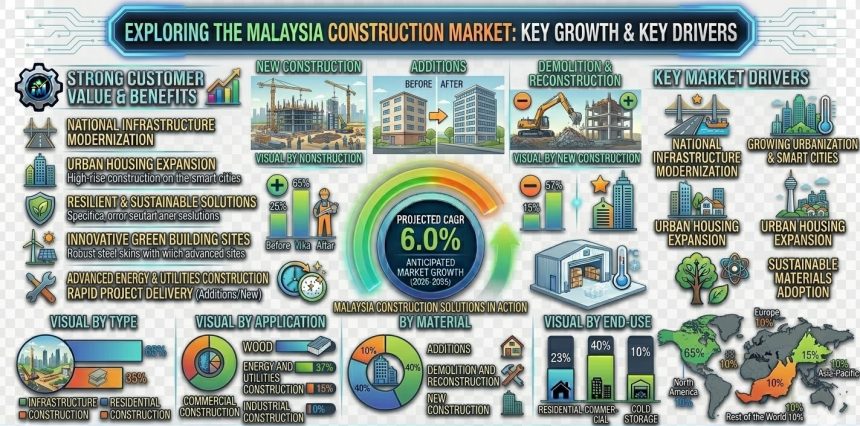
According to a detailed analysis by Market Research Future, the Malaysia construction market was valued at USD 35.4 billion in 2024 and is forecast to reach USD 67.2 billion by 2035, growing at a compound annual growth rate (CAGR) of 6.0% during the forecast period 2025–2035. This near-doubling of market size over a decade reflects the convergence of multiple growth catalysts — from state-led megaprojects to private sector residential booms and an accelerating embrace of construction technology.
The Engines of Growth
Government investment stands as the most visible and impactful driver of the Malaysia construction market. The Malaysian government has committed an estimated RM 100 billion across infrastructure projects over the next five years, covering transportation corridors, energy systems, and public facilities. Flagship connectivity projects — including expanded rail networks and regional highway programs — are creating a cascading effect on construction demand across multiple sectors and geographies within the country.
Urbanization is the second major force reshaping the industry. Malaysia’s urban population is projected to reach approximately 80% of total population by 2030, generating intense demand for new housing, commercial real estate, transit infrastructure, and utilities. This demographic reality is already translating into a robust pipeline of residential and mixed-use construction projects across the Klang Valley, Penang, and Johor Bahru.
Get An Exclusive Sample of the Research Report: https://www.marketresearchfuture.com/sample_request/21317
Foreign Direct Investment is the third pillar of market expansion. Malaysia attracted FDI inflows exceeding RM 50 billion in 2024 alone, with a substantial share directed toward construction and real estate. The country’s strategic location within ASEAN, combined with the government’s proactive policy environment and improvements to the ease of doing business, has made it an increasingly attractive destination for regional and global investors. Landmark developments such as the 150MW Sedenak data center campus in Johor Bahru — one of the largest in Southeast Asia — exemplify the scale of investment now entering the market.
Technology Transforming the Build
The Malaysia construction market is not just growing — it is modernizing. The adoption of Building Information Modeling (BIM) is gaining meaningful traction among large contractors, enabling better project visualization, cross-discipline coordination, and cost control. Prefabrication and industrialized building systems (IBS) are reducing on-site labor requirements and accelerating delivery timelines. The integration of IoT and AI into site management is improving safety monitoring, equipment utilization, and resource planning.
Industry reports suggest that technology adoption could improve overall construction productivity by up to 30% over the coming years — a transformative prospect for a sector that has historically been labor-intensive and susceptible to delays. The government’s New Industrial Master Plan (NIMP) 2030 is further reinforcing this shift, laying out a framework for upgrading Malaysia’s industrial and infrastructure base toward higher-value, technology-equipped capabilities.
Segment Highlights: Residential Leads, Public Sector Surges
Within the market’s sector breakdown, residential construction holds the largest share — driven by housing demand from a growing urban population and the government’s affordable housing initiatives targeting middle- and lower-income groups. Infrastructure construction follows closely, anchored by spending on roads, rail, ports, and utilities that underpin Malaysia’s broader economic connectivity goals.
The public sector is the fastest-growing end-use segment, buoyed by rising government expenditure on transportation, education, and healthcare infrastructure. While the private sector remains the dominant overall player — given its involvement across residential, commercial, and industrial developments — the gap is narrowing as public-sector project pipelines expand.
Buy this Premium Research Report: https://www.marketresearchfuture.com/checkout?currency=one_user-USD&report_id=21317
From a contractor size perspective, large contractors like Gamuda Berhad, IJM Corporation, and Sunway Construction Group continue to anchor the market by securing major infrastructure and commercial contracts. However, small and medium contractors are gaining ground, particularly in renovation, green building retrofits, and specialized trades — a reflection of the market’s growing complexity and diversification.
Sustainability: The Next Frontier
Green building is transitioning from a niche aspiration to a mainstream market expectation in Malaysia. The Green Building Index (GBI) is driving the adoption of energy-efficient designs, sustainable materials, and environmentally responsible construction practices. The market for sustainable construction is projected to grow approximately 20% annually — a trajectory that positions Malaysia as an emerging leader in responsible building within Southeast Asia.
For more insights on Market, visit the Market Research Future page and explore detailed market analysis, forecasts, and company strategies.